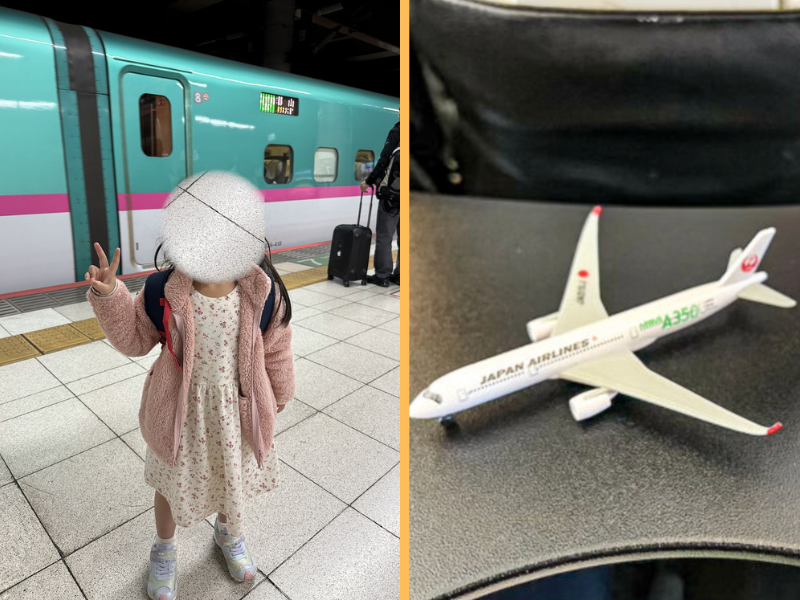
Traveling with young children is a joy, but getting to your destination can be the most stressful part of the trip. As parents, we worry: “Will my child cry and disturb others?” “Will they be able to sit still?”
When traveling within Japan, the biggest debate is often between the speed of the Airplane and the flexibility of the Shinkansen (Bullet Train). As a mom living in the Kanto region with a 5-year-old daughter, I have traveled extensively using both methods. In this guide, I will compare them in detail to help you decide which is best for your next family adventure.
Pros and Cons: Shinkansen vs. Airplane for Families
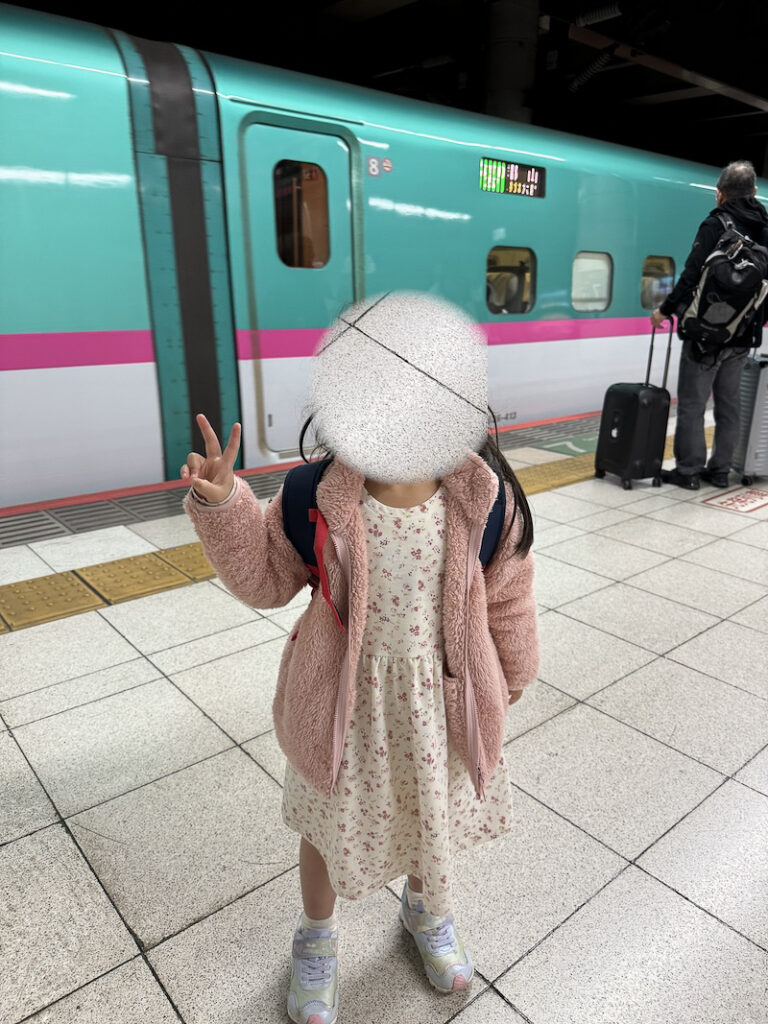
First, let’s break down the main advantages and disadvantages of each mode of transport. Your choice will likely depend on your destination and your child’s age.
Pros of the Airplane
- Speed: Drastically shorter travel time for long distances (essential for Hokkaido or Okinawa).
- Airport Fun: Airports in Japan are like shopping malls with great facilities.
- Onboard Service: Toys and drinks are provided, making kids feel special.
- Cost: Children under 3 years old fly free (on lap) for domestic flights.
- Support: Flight attendants are very attentive to families.
Cons of the Airplane
- Airport Access: Getting to the airport takes time, and security checks are a hassle with kids.
- Confinement: You cannot stand up during takeoff, landing, or turbulence.
- Ear Pain: Changes in air pressure can hurt sensitive little ears.
- No Escape: If your child cries, there is nowhere to go, which is stressful for parents.
Pros of the Shinkansen (Bullet Train)
- Accessibility: Depart directly from city centers like Tokyo Station.
- Space: Seats are spacious with plenty of legroom.
- Freedom: You can walk to the deck area if your child gets fussy.
- Cost: Children under 6 (preschoolers) ride free in non-reserved seats or on your lap.
- Flexibility: Trains run frequently, and changing times is easier.
Cons of the Shinkansen
- Time: For very long distances (like Fukuoka), it takes too long, and kids get bored.
- Crowds: During holidays, non-reserved cars can be packed, risking no seats.
- Less Entertainment: Unlike planes, there are no toys given out.
- Tunnels: On some routes, long tunnels mean no view and popped ears.
Price Considerations
Cost is vital for families. Flights can be surprisingly cheap if you use LCCs or early-bird fares. However, on planes, children aged 3 and up pay child fares (usually 50-75% of adult fares).
In contrast, on the Shinkansen, children under 6 (preschoolers) travel free if they don’t occupy a reserved seat (i.e., they sit on your lap). Now that my daughter is 5, she is heavy, so we sometimes pay the child fare to reserve a separate seat for her comfort and ours, but having the option to go for free is a significant budget saver.
Seat Comfort and Onboard Amenities
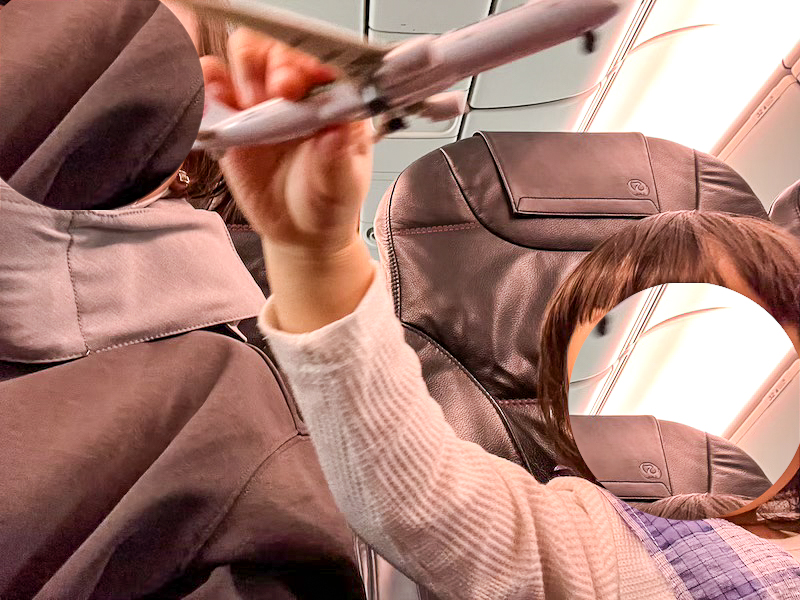
The quality of the “living space” during travel makes a huge difference.
Seat Width and Space
Shinkansen: The seat pitch on the Bullet Train is generous. Even with a backpack at your feet, there is room. If you book the “Seats with Oversized Baggage Area” at the back of the car, you can often store a stroller without folding it—a lifesaver if your child is asleep in it. The tray tables are large and stable, perfect for drawing or eating. Most newer trains have power outlets at all seats for charging tablets.
Airplane: Economy seats are narrow. If the person in front reclines, it feels very cramped. I spend the whole flight stopping my 5-year-old from kicking the seat in front, which is exhausting. However, full-service carriers like JAL and ANA provide original toys or picture books, which are excellent for buying 30 minutes of peace. Blankets are also available to help with temperature control.
Toilets and Diaper Changing
Shinkansen: The “Multi-purpose Room” and spacious Western-style toilets on the Shinkansen are a parent’s best friend. They have diaper changing tables and enough room for a parent to assist with clothing changes easily. Also, the washbasins are often located outside the toilet in the aisle, making it easy to wash sticky hands.
Airplane: Airplane lavatories are tiny. While they have changing tables, changing a diaper while standing in that confined space is an acrobatic feat. Furthermore, you cannot use the restroom when the seatbelt sign is on. If your child suddenly says, “I need to pee!” during descent, you are out of luck.
Entertainment and Activities for Kids

How do you keep them occupied? This is the ultimate challenge.
Staying Entertained
Airplane: The novelty of “flying in the sky” is unbeatable. Looking out the window at the clouds or tiny houses keeps my daughter fascinated. In-flight Wi-Fi video programs and magazines are helpful. The best moment is when the Flight Attendants bring gifts like stickers or model planes—it instantly fixes a bad mood.
Shinkansen: The strength of the train is freedom. If my child gets bored or loud, we can go for a walk to the deck. Watching the scenery rush by or walking between cars feels like a little adventure. While Wi-Fi is available, be warned that it often cuts out in tunnels, so always download movies or games to your device beforehand.
Safety and Staff Support
Flight attendants are professionals at dealing with families. They can help prepare hot water for formula and will often check in on you. The Shinkansen staff (conductors) patrol the train but generally leave passengers alone. If you need active assistance, the airplane offers a more supportive environment.
Dining Options: Ekiben vs. In-Flight Snacks
Eating is part of the travel fun.
In-Flight Dining
On domestic flights, there are generally no meals, only drink services. Airlines usually provide cups with lids and straws for kids to prevent spills. You can bring baby food, but warming it up depends on the airline and aircraft. Since the tray tables are small, I recommend bringing easy-to-eat snacks like rice balls (Onigiri) or bread that won’t make a mess.
The “Ekiben” Experience
The highlight of the Shinkansen is the Ekiben (station bento box). Major stations like Tokyo Station have huge shops with hundreds of options, including bento boxes shaped like Bullet Trains (Shinkansen E5 Hayabusa, etc.). Choosing one is an event in itself. Since the train ride is smooth and the tables are large, you can enjoy a proper meal together. You can feed your baby comfortably without worrying too much about the smell, but remember there are no microwaves, so bring food that tastes good at room temperature.
Summary

To conclude, how do we decide between the Airplane and the Shinkansen for our family trips? It all comes down to travel time.
Actually, I personally love airplanes and the excitement of airports! Fortunately, my 5-year-old daughter enjoys both flying and riding trains. So, our family rule is simple: “If the Shinkansen takes more than 4 hours, we fly.”
For destinations we can reach in about 3 hours, like Osaka or Sendai, we choose the Shinkansen. It allows us to relax and enjoy our Ekiben meals at a slower pace. However, for places like Hiroshima or Fukuoka, where the train ride exceeds 4 hours, we definitely choose the Airplane.
Sitting still for over 4 hours is hard even for adults. With a plane, even distant domestic destinations are only a 1.5 to 2-hour flight away. Even including the time at the airport, the total travel time is shorter, which helps keep my daughter in a good mood.
I recommend weighing the pros and cons of each and choosing the one that fits your destination best. Make the journey part of the fun! Have a wonderful trip!